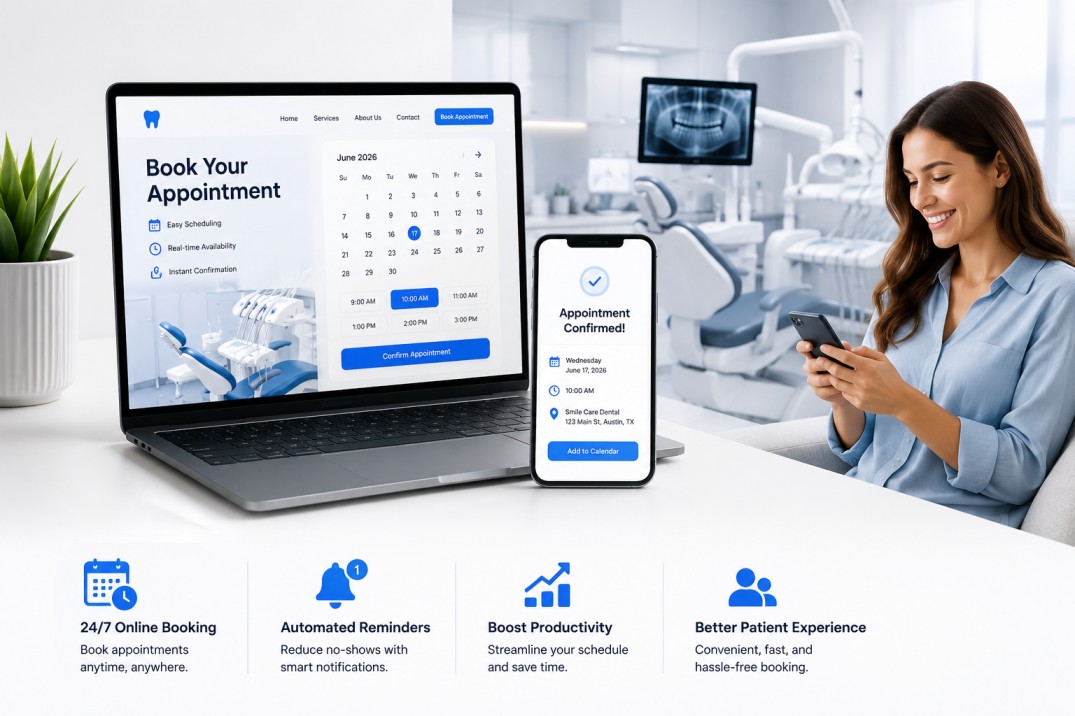
Imagine this: a patient searches "dentist near me" at 10pm on a Sunday, finds your clinic, and wants to book a cleaning. They click your phone number. It rings out. They move on to the next result — and that practice has online booking. You just lost a patient you never even knew existed.
This scenario plays out thousands of times every day across dental practices in the US. And it doesn't have to. Automated appointment booking for dental clinics has matured rapidly — and in 2026, it's no longer a luxury for large DSOs. It's a competitive necessity for any practice that wants to grow.
This guide covers everything: what automated dental scheduling actually is, the hard numbers behind why it works, how to choose the right system, and what implementation looks like in practice.
The Scheduling Gap Costing Dental Clinics Thousands Every Month
The data paints a stark picture of the opportunity most practices are leaving on the table:
- 82% of patients prefer to book appointments digitally — yet only 26% of dental practices offer any form of online or automated scheduling.
- 70% of appointment requests happen outside of traditional office hours, when your phone lines are either closed or understaffed.
- 61% of patients say online appointment scheduling is "extremely or very important" when choosing a new dental provider.
- Practices with a 15% no-show rate lose an average of $60,000 per year in missed appointments alone.
The gap between what patients expect and what most dental practices offer is enormous — and the practices that close that gap are capturing patients that everyone else is losing.
What Is Automated Appointment Booking for Dental Clinics?
Automated dental appointment booking is a system that allows patients to schedule, confirm, reschedule, or cancel appointments without involving a human receptionist. It operates 24/7, connects directly to your live schedule, and updates your practice management software in real time.
There are two main forms this takes:
1. Online Self-Scheduling (Web and Mobile)
A booking widget embedded on your website, Google Business Profile, or Facebook page. Patients select their appointment type, choose from available time slots, and confirm — in under two minutes. The booking writes directly into Dentrix, Eaglesoft, Open Dental, or your PMS of choice. No phone call required. No staff involvement.
2. AI Voice Booking (Phone-Based)
A more advanced layer: an AI voice agent that handles inbound calls, understands what the patient needs, checks your live calendar, and books the appointment over the phone — automatically, 24/7. This is critical because a large portion of your patients still call. Many prefer it, especially for new patient inquiries, insurance questions, or anything more complex than a routine booking.
The most effective practices in 2026 use both: online booking for patients who prefer digital, and AI voice for those who call.
How Automated Booking Reduces No-Shows (With Real Numbers)
No-shows are one of the most financially damaging problems in dental practice management. An empty chair doesn't just represent a missed appointment — it represents the overhead cost of staff, rent, and utilities with zero corresponding revenue.
Automated booking addresses no-shows in two powerful ways:
Automated Confirmations and Reminders
A landmark study analyzing over 1.6 million dental appointments found that automated reminders reduced no-show rates by 22.95%. More targeted studies show SMS reminders alone reducing no-shows by 38–50%, with some practices achieving 60–70% reduction when reminders include an easy one-tap rescheduling option.
The mechanism is simple: patients who confirmed their appointment a week ago, had a reminder sent 48 hours before, and received a final reminder the morning of — show up. Patients who booked three weeks ago and heard nothing often simply forget, especially for non-urgent cleanings.
Frictionless Rescheduling
When patients can't make their appointment, the old process was a missed call, a voicemail, a callback, a phone tag. Automated systems let patients reschedule via text or email link in 30 seconds. That means the chair gets refilled by someone else rather than sitting empty. Practices implementing this consistently report their cancellation-to-rebook conversion rates more than doubling.
The Revenue Impact: Breaking It Down
Let's be specific. Here's what automated appointment booking realistically delivers for a mid-size single-location dental practice:
Captured After-Hours Bookings
If your practice receives 50 calls per day and 35% happen after hours (a conservative estimate), that's roughly 17–18 daily after-hours call attempts. Without 24/7 coverage, most become missed bookings. At a 30% conversion rate and $220 average appointment value:
- 17 after-hours calls × 30% = ~5 bookings per day
- 5 × $220 × 250 working days = $275,000 in annually captured revenue
Even at a fraction of that — say 10% of after-hours callers booking — the incremental annual revenue runs well into five figures.
No-Show Reduction
A practice with 20 no-shows per month at $220 per appointment is losing $4,400/month, or $52,800/year. A 40% reduction from automated reminders recovers $21,120 annually. A 60% reduction recovers over $31,000.
Staff Efficiency Gains
The average dental receptionist spends 2–3 hours daily on scheduling-related phone calls. Automating routine bookings, confirmations, and reminders gives that time back for higher-value patient interactions, reducing burnout and turnover (which costs $11,000–$14,000 per receptionist to replace).
What to Look for in a Dental Appointment Booking System
Not all automated booking platforms are equal. Here's what separates the solutions that actually work from the ones that frustrate patients and staff alike:
Real-Time PMS Integration
This is non-negotiable. Your booking system must connect live to your practice management software — Dentrix, Eaglesoft, Open Dental, Curve Dental — and read and write in real time. Any system that creates a "pending request" that a human must manually enter into your PMS is not true automation; it's just a digital phone message. You still have the same bottleneck.
Appointment Type Intelligence
Not all appointments are the same length or complexity. A new patient exam takes 90 minutes. A follow-up X-ray takes 20. An emergency exam needs immediate triage. Your booking system must understand these distinctions and book the right slot with the right provider for the right duration — automatically.
Insurance Verification Integration
Advanced systems capture insurance information at booking and run a verification check before the appointment. This eliminates a major time-sink for front desk staff and prevents billing surprises that damage patient relationships.
Multi-Channel Reminders
Patients have preferences. Some want a text. Some want an email. Some still want a call. Your system should support all three, and allow patients to choose their preference at the time of booking. One-size-fits-all reminder systems have significantly lower engagement rates than multi-channel approaches.
HIPAA Compliance
Any system handling patient data, including appointment details, must be fully HIPAA compliant. Request the vendor's BAA before implementation. This is a legal requirement, not a preference.
The Patient Experience: Why It Matters as Much as the Tech
It's easy to get lost in features and integrations and forget that the patient experience is what drives referrals, reviews, and long-term retention. A well-implemented automated booking system dramatically improves patient experience:
- No hold time. Patients book when they want, in under two minutes, without waiting on hold or leaving a voicemail.
- Confirmation immediately. Patients receive an immediate confirmation SMS and email — the instant reassurance that their appointment is real and locked in.
- Easy changes. One link to reschedule, not a game of phone tag.
- Prepared on arrival. Automated intake forms sent before the appointment mean less time on paperwork in the waiting room.
These touchpoints combine to create an experience that patients describe as "professional" and "modern" — and those patients leave 5-star Google reviews that drive more patients through your door.
Choosing Between a Standalone Booking Tool and an AI Voice Agent
A standalone online booking widget solves the digital channel. It doesn't solve the phone channel. And for dental practices, the phone still accounts for the majority of new patient inquiries — particularly for older demographics, patients with insurance questions, or anyone dealing with a dental issue who wants to speak with someone before committing to an appointment.
An AI voice agent solves both simultaneously: it handles phone calls the way a human receptionist would, and it integrates the same automated booking and reminder functionality. For practices serious about capturing every patient opportunity, the combination of online booking and AI voice is the complete solution.
Implementation: How Fast Can You Go Live?
One of the most common objections from practice owners is concern about setup complexity. The reality in 2026 is that implementation is significantly faster than most expect:
- Day 1: Discovery — map your appointment types, providers, schedule rules, and patient flow.
- Days 1–2: Configuration and PMS integration — connect the system to your live schedule.
- Day 2: Testing — run through booking scenarios across all appointment types before going live.
- Go live: Add the booking widget to your website and Google Business Profile. Enable AI voice on your phone number. Done.
Most practices are fully live within 48 hours. Staff training takes under 30 minutes — primarily covering how to view AI-handled bookings in the dashboard and how to override the system for edge cases.
The Bottom Line: This Isn't Optional Anymore
In 2026, patients don't distinguish between "the clinic couldn't answer" and "the clinic doesn't care." Unanswered calls, full voicemail boxes, and no online booking option all send the same signal: this practice isn't set up to serve me conveniently. And they move on.
The practices growing fastest right now aren't necessarily the ones with the best clinical team alone. They're the ones combining excellent care with systems that make it effortless for patients to book, show up, and come back. Automated appointment booking is the foundation of that system.
If you're ready to see what fully automated dental scheduling looks like in action — including AI-powered phone booking that integrates directly with your PMS — book a free demo with Controx. We'll show you exactly how it works for a clinic your size, and give you a live demonstration using your own appointment types.